
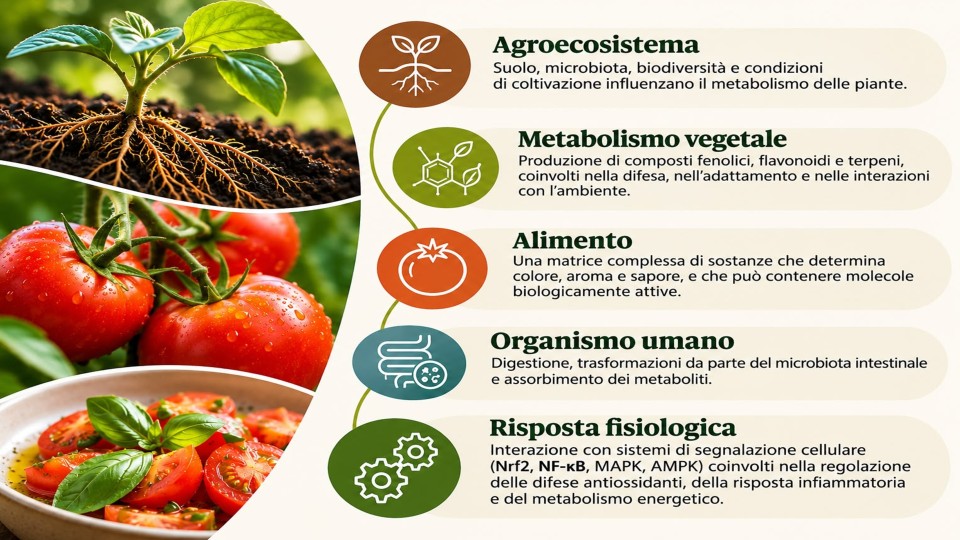
Food as a metabolic expression of the agroecosystem
Food as a metabolic expression of the agroecosystem and a potential modulator of human physiology
When we eat a tomato, an apple or an orange, we are accustomed to focusing primarily on its nutritional content: vitamins, minerals, fibre, sugars and other substances that are beneficial to our bodies.
But is a food really just the sum of the molecules it contains?
As an agronomist, even before being a nutritionist, I am used to observing what happens before harvesting.
A plant grows, interacts with the soil environment, responds to light, temperature, and the availability of water and nutrients.
It defends itself against stress and communicates with the organisms around it.
All these interactions influence its metabolism and, consequently, can also modify the composition of the foods derived from it.
It is precisely this consideration that I would like to use as a starting point to propose a different perspective on the relationship between agriculture, food and human health.
Does the taste of food tell us something about its biochemistry?
An interesting scientific paper published in 2025 in the journal Nutrients, by Kurhaluk and colleagues, examines the role of phenolic compounds, flavonoids and terpenes in determining the sensory and functional properties of plant-based foods.
These are substances that we primarily recognise through our senses.
Limonene, for example, contributes to the characteristic aroma of citrus fruits; quercetin, found in apples and onions, can contribute to bitter and astringent sensations; catechins play a role in the taste of tea and cocoa.
However, plants do not produce these molecules to satisfy our palate.
They are part of plant metabolism and perform various functions in adaptation, protection and interaction with the environment.
Their production depends on complex biochemical pathways, such as the shikimate and phenylpropanoid pathways, which are involved in the synthesis of numerous phenolic compounds, and the mevalonate and methylerythritol phosphate pathways, from which terpenes are derived.
The biochemical activity of these metabolic pathways can be modified by environmental conditions and by the stimuli (including low-grade stress) that plants experience throughout their development.
This means, for example, that two fruits from different plants belonging to the same cultivated variety may exhibit different phytochemical profiles depending on numerous factors, including environmental conditions, cultivation practices and management techniques.
This is why, when discussing the quality of plant-based foods, we cannot ignore the agricultural system in which they are produced.
A paper published in Nutrients highlights a particularly interesting aspect: some of the molecules that contribute to the taste, aroma and colour of foods can also interact with the biological regulatory systems of the human body.
Polyphenols, for instance, do not simply act as substances capable of directly neutralising free radicals; they can also influence specific cellular signalling pathways.
One of these is Nrf2, which is involved in regulating endogenous antioxidant defences, including enzymes such as SOD (superoxide dismutase), CAT (catalase) and glutathione peroxidase.
Other compounds can modulate NF-κB, one of the major pathways involved in regulating the inflammatory response, as well as biochemical systems such as MAPK and AMPK, which are involved, respectively, in cellular responses to stimuli and the regulation of energy metabolism.
In other words, certain molecules found in foods can act as modulators of physiological processes, helping to regulate cellular activity.
Of course, we must distinguish between the demonstration of these mechanisms, often obtained through laboratory experiments or animal models, and their actual clinical relevance in humans.
Nevertheless, their biological significance remains important: food does not merely provide energy and the materials required for the body to function; it can also contain substances capable of interacting with its signalling systems.
There is another aspect that I consider fundamental.
The presence of a biologically active substance in a plant-based food does not automatically guarantee that it will exert a particular physiological effect.
We must consider the food matrix, bioavailability, digestive transformations and, above all, the role of the gut microbiota.
Indeed, many polyphenols are transformed by intestinal microorganisms into metabolites that may have different biological properties from those of the molecules originally ingested.
This creates a two-way interaction: substances contained in foods can influence the microbiota, while the microbiota itself helps determine their metabolic fate.
Food processing also plays a particularly important role.
Fermentation, for example, can modify the structure of phenolic compounds, in some cases increasing their bioavailability. Conversely, intensive heat treatments can degrade certain molecules or promote the loss of volatile aromatic compounds.
This reminds us that the functional quality of a food does not depend exclusively on the concentration of substances present at harvest, but also on the transformations they undergo before and after consumption.
Therefore, if growing conditions influence plant metabolism, and if certain plant metabolites can interact with human physiology, it becomes particularly interesting to investigate the role of the entire agroecosystem in determining the functional quality of food.
Soil biological fertility, interactions between roots and microorganisms, uncultivated biodiversity and stress management could all represent important tools for influencing the metabolic composition of agricultural produce.
This does not mean claiming that food produced using a particular agricultural technique is automatically better for human health.
Such a relationship must be verified through metabolomic analyses, bioavailability studies and assessments of physiological responses in humans.
However, we need to start considering agriculture not merely as a system for producing biomass and nutrients, but also as a set of biological processes that contribute to determining the chemical composition of food.
From this perspective, agroecology and human nutrition become deeply complementary disciplines.
Food represents a potential functional continuum between the metabolism of the agroecosystem in which it was produced and the physiological processes of the organism that consumes it.
The current challenge is not simply to produce foods richer in bioactive compounds, but to understand how production conditions, the food matrix and human metabolism interact to determine measurable physiological responses.
It is along this biological continuum that agriculture and nutrition must build new research perspectives, connecting the health of agroecosystems with the quality of the food we eat.
Francesco Di Lorenzo
Agronomist & Nutritionist
References consulted
Kurhaluk, N., Buyun, L., Kołodziejska, R., Kamiński, P., & Tkaczenko, H. (2025).
Effect of phenolic compounds and terpenes on the flavour and functionality of plant-based foods. Nutrients, 17(21), 3319.
https://doi.org/10.3390/nu17213319